Nine months, a garage workshop and AI as my tutor.
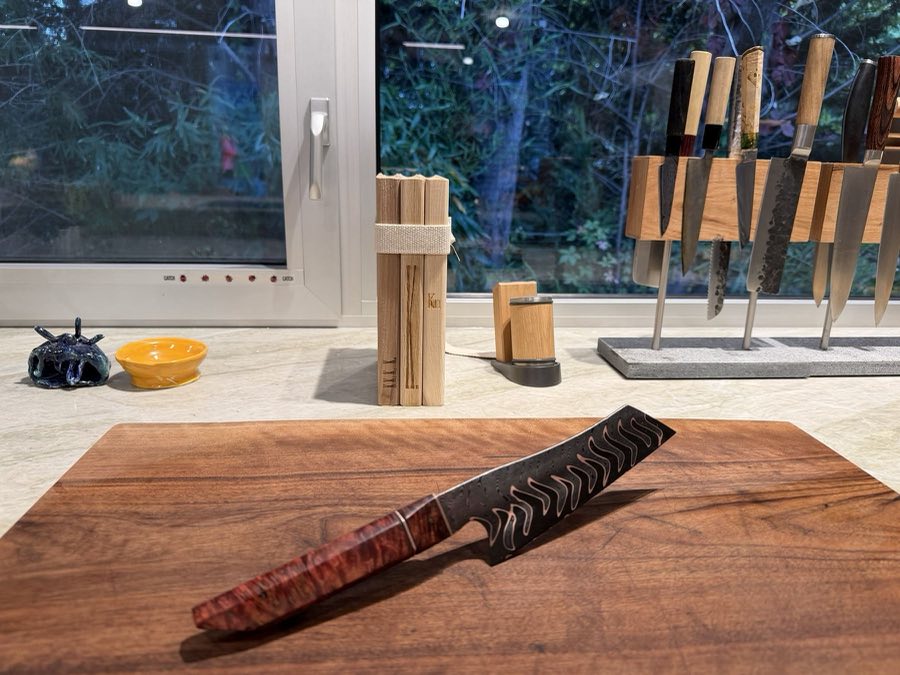
I wanted a skill that lives in the hands, not on a screen.
By day I am the CEO of a software company. I wanted something that would challenge me in a completely different way.
I started programming at sixteen and have been building teams, products and companies ever since. I founded a startup and sold it, led a product and engineering organisation of 260 people, and today I am the CEO of a company of 400. Outside work I am a father of two and an ultrarunner. I have finished Ironmans and a 100-mile race, and I learned along the way that hard things are mostly a matter of showing up every day.
I have always been handy and I like making things. I had been collecting knives for years. Since I was young I have been drawn to Japanese culture, and I trained aikido for years. Knives sit right where all of that meets.
I hear a lot of people say that AI will take our jobs and make us stupid. I see it differently. AI can teach us more than ever before: learning is easier, finding information is easier, research is easier. What matters is whether we want to learn, and what we choose to use it for.
So I used it to learn a craft that usually takes years at a master's bench. Claude was my tutor for everything in this workshop, from the first question about steel to the finished knife. This site is my attempt to show what that looks like.
The traditional way in is an apprenticeship: three to five years next to a master. I gave myself one year and an AI tutor.
In December I started 100 Sharp, a 100-day challenge for body, mind and habits. One of its daily tasks is to learn a new skill. Mine was knifemaking.
I learned the way a curious beginner would, with a very patient teacher. I watched makers on YouTube, paused the video and sent screenshots to Claude: what tool is that, why is he doing it this way, where do I buy it in Europe?
Conversation by conversation we went through steels, heat treatment, grinds, handle geometry, wood stabilising, etching chemistry and safety. Every answer led to the next question.
The workshop grew one tool at a time in half of our garage, which Diana gave up for it. I planned the layout, the power and the dust extraction with AI before buying anything. Then the machines, each one researched before it was bought.
- 2×72" belt grinder
- Heat-treat kiln, PID
- Tempering oven
- LN₂ dewar for cryo
- CNC router
- 3D printer
- Scroll saw
- Pneumatic engraver
- Lapidary saw
- Stabilising rig
- Cyclone dust extraction
- PAPR respirator
The notes got too big for chat, so we turned them into a book on knifemaking: everything I learned, in the order I needed it. Next to it sits a workshop catalog: every tool, material and supplier, with what it is for and where it came from.
Both are open to anyone who joins the Knife Book: the full book and the list of suppliers I use.